Metallized Film Printing
Printing adds brand artwork to metallized film while keeping the reflective surface where the design needs it. The print method, ink system and surface treatment determine the final look and durability.
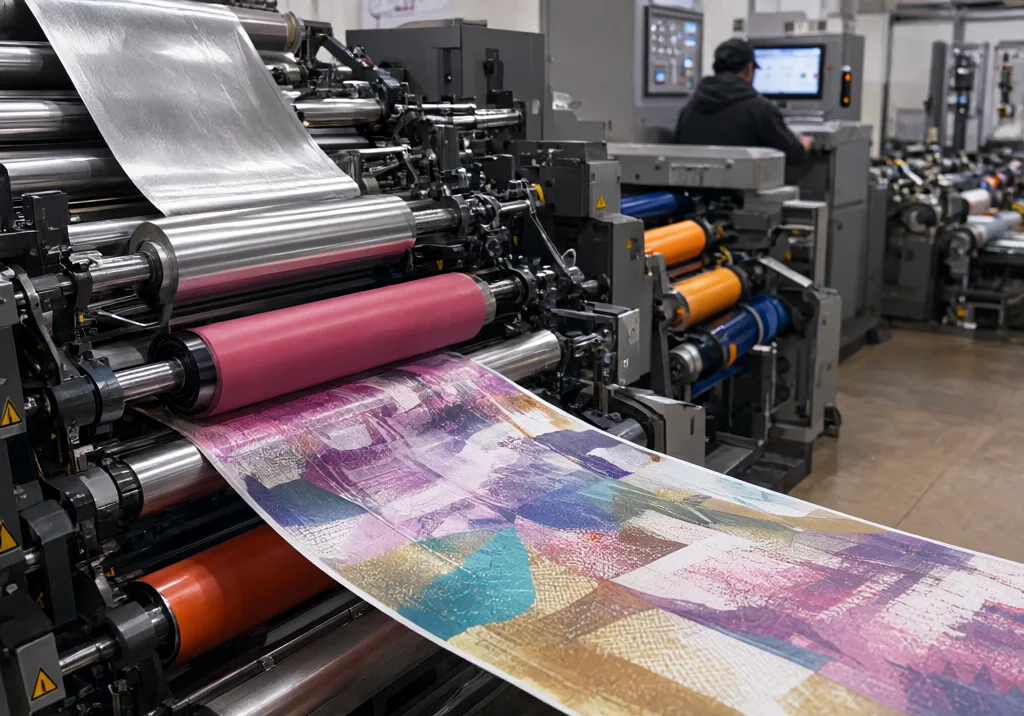
PacksFactory reference page for metallized film printing and related film formats. Temporary imagery; the supplied material is confirmed against the approved sample.
Print Methods
Flexo and gravure are common for metallized film because they handle roll-to-roll production and repeat orders. Digital printing can suit shorter runs and design testing, but the ink and finish must be compatible with the film.
Printing on Metal
Metallized surfaces reflect light and change ink appearance. Transparent inks let the metal show through, while opaque whites and colors create flat areas. The design should be built around those differences rather than treated like white paper.
Surface Treatment
Film may need corona treatment or a primer to hold ink and adhesive. The treated side, treatment level and shelf life should be confirmed by the converter, especially for metallized surfaces that can be sensitive to handling.
Proofing and Production
A printed proof or sample on the actual film is the best way to approve color, gloss and metallic effect. The approved proof becomes the reference for the production run.
Metallized Film Printing Details
Metallized film printing is a design and production decision, not only a color decision. The metallic surface reflects light, so the same ink can look darker, lighter or more saturated than it does on white paper. Transparent inks preserve the metal and create a moving reflective background, while opaque inks create solid brand areas that block the metal.
Flexo and gravure are the usual production methods for printed metallized film. Flexo is common for labels, bags and shorter to medium runs. Gravure gives fine detail and consistent long-run color, but it needs cylinders and a larger volume. Digital printing can be useful for prototypes and short runs, provided the ink and finishing are suitable for the film.
Surface treatment is critical. A film that prints well in a lab may fail on a production press if the treatment level is wrong or has aged. The converter should confirm the print side, treatment, ink system, drying conditions and any primer. For laminated structures, the adhesive and the print side also need to be compatible.
PacksFactory coordinates printed metallized film with qualified printers and converters. Send the artwork, film type, print method preference, colors, finish, roll or pouch format, quantity and destination country so the print route and sample path can be confirmed.
Metallized Film Printing for Packaging and Converting Projects
Use this page to compare metallized film printing, film grades, thickness and width options, lamination structures, printing and converting requirements before requesting a quote. PacksFactory keeps the review focused on the finished pack, documentation and a repeatable roll or converted format.
How Metallized Film Printing Is Specified for Production
Use this page as a sourcing brief for buyers comparing substrate, thickness, barrier, roll dimensions, print and converting requirements before requesting a quote.
| Decision Area | Production Detail |
|---|---|
| Primary search intent | metallized film printing, printed metallized film, metallized film print, custom printed film |
| Best-fit film use | Flexo, gravure and digital print options; Transparent and opaque ink effects; Surface treatment and adhesion control |
| Specification decisions | substrate, thickness, metallized side, roll width, core, treatment, barrier target, laminate structure, print method, converting route |
| Quote inputs | film or laminate type, substrate and thickness, roll width and length, core ID and outside diameter, surface treatment, print or converting plan, quantity, destination country |
Our team reviews film grade, barrier target, converting route, roll packing and delivery planning before quoting.
Our team reviews film grade, barrier target, converting route, roll packing and delivery planning before quoting.
Our team reviews film grade, barrier target, converting route, roll packing and delivery planning before quoting.
Our team reviews film grade, barrier target, converting route, roll packing and delivery planning before quoting.
Can metallized film be printed with full-color artwork?
Yes. Flexo, gravure and digital printing can be used, but the ink and surface treatment must suit the film. A proof on the actual material is recommended.
How does printing change the metallic effect?
Transparent inks let the metal show through, while opaque inks block it. The design should account for the reflective surface and the way it shifts under light.
What is the minimum print quantity?
It depends on the print method, film type, artwork and finishing. Gravure usually needs a larger volume than flexo or digital, and the minimum is confirmed after the specification is reviewed.
Can printed film be converted into pouches?
Yes. Printed film can be laminated, slit and converted into pouches or bags. The print direction and seal areas should be planned with the converter.